
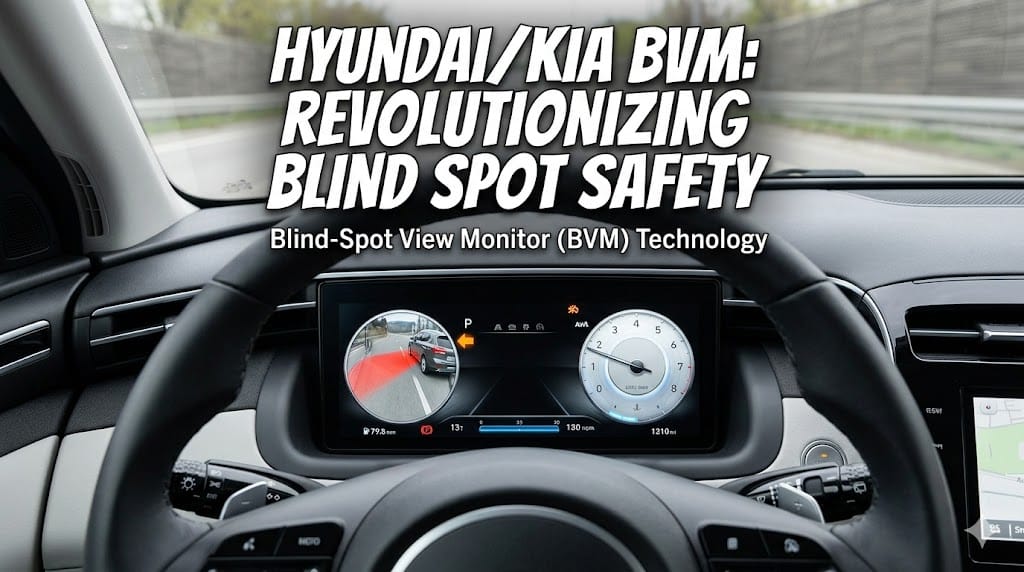
Blind Spot View Monitor: The Hyundai and Kia Feature Every Driver Needs
Changing lanes on a busy highway can be stressful, even with traditional blind-spot sensors. Hyundai and Kia have addressed this common driving anxiety with a practical piece of technology called the Blind Spot View Monitor (BVM). Unlike standard alerts that just beep or flash a light, BVM shows you exactly what is happening in your danger zones.
What is Blind Spot View Monitor (BVM)?
The Blind Spot View Monitor is a safety system that displays a live video feed of your vehicle’s blind spots directly onto the digital instrument cluster. When you activate your turn signal, the speedometer or tachometer circle transforms into a clear camera view of the lane next to you.
How It Works in Real-World Driving
The system uses wide-angle cameras mounted on the underside of your side mirrors. Here is the step-by-step process of how you use it every day:
- Signal to Turn: When you flip your turn signal stalk (left or right), the system instantly activates.
- Visual Confirmation: A circular video feed appears on the dashboard in your line of sight. If you signal left, the left dial shows the left lane. If you signal right, the right dial shows the right lane.
- Wide Angle View: The cameras capture a much wider angle than a traditional glass mirror, revealing cyclists, small cars, or debris that might be hidden from view.
Why This Matters for Modern Drivers
Standard blind-spot monitoring uses radar to trigger a small light in your side mirror. While helpful, it doesn’t give you visual context. BVM solves several real-world problems:
- Confidence in Heavy Traffic: You no longer have to rely solely on a sensor; you can see the actual distance between your bumper and the car behind you.
- Rain and Night Driving: Side mirrors can become obscured by rain droplets or glare. The BVM cameras are positioned and calibrated to provide a clearer image in low-visibility conditions.
- Eliminating the ‘Head-Check’ Strain: While you should still be aware of your surroundings, BVM reduces the need for aggressive neck-straining head checks, keeping your focus more forward-oriented.
Is It Easy to Use?
There is no learning curve. Because the video feed is triggered by the turn signal—a habit every driver already has—it becomes a natural part of your driving flow within minutes of getting behind the wheel. It is currently available on most higher-trim levels of popular models like the Hyundai Tucson, Kia Telluride, and the EV6.
Final Verdict
The Blind Spot View Monitor is one of those rare automotive innovations that isn’t just a gimmick. It provides a practical, visual solution to the age-old problem of blind spots, making every lane change safer and more predictable for beginners and experienced drivers alike.