
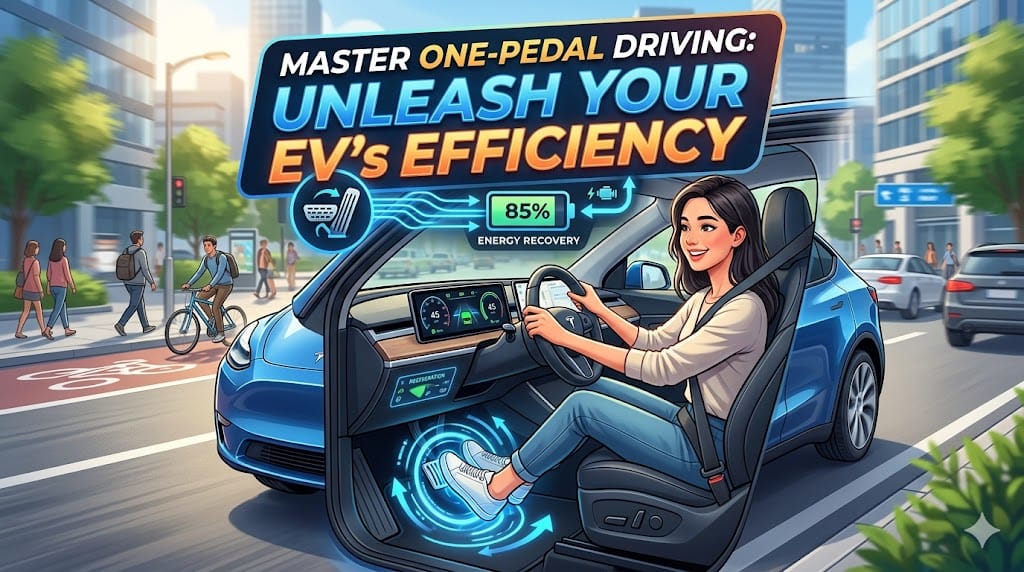
How to Master One-Pedal Driving: A Beginner’s Guide
If you’ve recently switched to an electric vehicle (EV) like a Tesla, Hyundai Ioniq, or Ford Mustang Mach-E, you’ve likely encountered a feature called One-Pedal Driving. While it sounds intimidating at first, it is one of the most rewarding features of modern car technology once you know how to use it.
What Exactly is One-Pedal Driving?
One-pedal driving allows you to speed up, slow down, and even come to a complete stop using only the accelerator pedal. When you press down, the car moves forward like usual. However, the moment you lift your foot off the pedal, the car begins to decelerate significantly without you ever touching the brake pedal.
The Secret Sauce: Regenerative Braking
This feature works through a process called regenerative braking. In a gas car, braking turns kinetic energy into heat, which is wasted. In an EV, when you lift off the accelerator, the electric motor reverses its role and acts as a generator. This creates resistance that slows the car down while simultaneously sending electricity back into the battery. It’s like getting free fuel every time you slow down!
How to Use It Practically
- The Feathering Technique: Instead of lifting your foot off the pedal completely, learn to lift it slowly. Think of the pedal as a slider rather than an on/off switch.
- Anticipate Stops: Look further down the road. If you see a red light ahead, start easing off the pedal early. The car will glide to a stop perfectly at the line.
- Safety Check: Don’t worry—your brake lights still turn on automatically when the car detects significant deceleration, even if you aren’t touching the brake pedal.
Why Should You Use It?
Beyond the cool factor, one-pedal driving offers two major benefits:
- Extended Range: By recapturing energy that would otherwise be lost, you can add several miles of range to your daily commute.
- Less Maintenance: Because the motor is doing the heavy lifting to slow the car, your physical brake pads and rotors will last significantly longer.
When to Use the Actual Brake Pedal
One-pedal driving is perfect for stop-and-go city traffic and casual cruising. However, you should still keep your foot ready for the traditional brake pedal during emergency stops or when driving in slippery, icy conditions where the car’s computer might need to manage traction differently. Mastering this feature makes driving less stressful and much more efficient.