
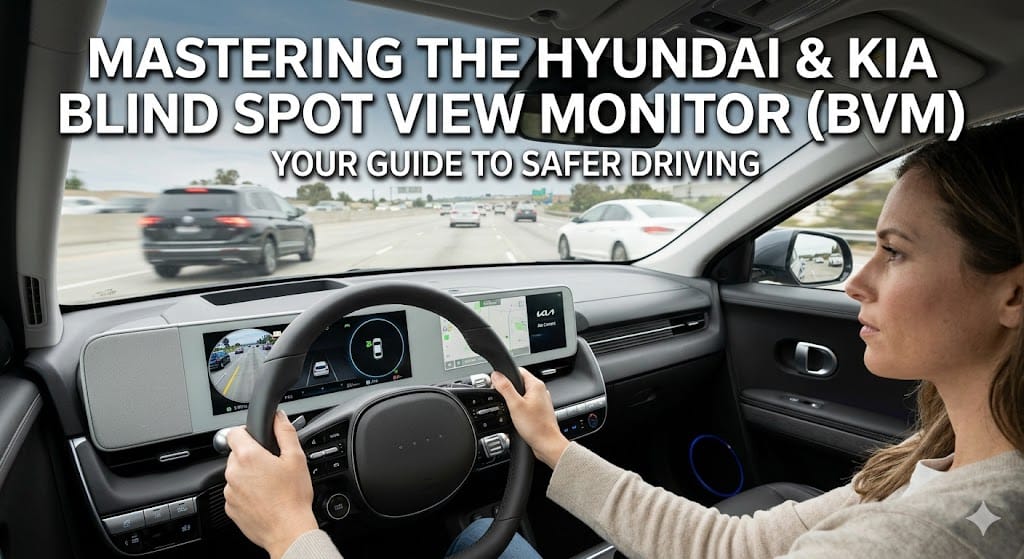
Mastering the Hyundai and Kia Blind Spot View Monitor (BVM)
Checking your blind spots is one of the first things you learn in driving school, but even with perfectly adjusted mirrors, small cars or motorcycles can vanish from sight. To solve this, Hyundai and Kia introduced the Blind Spot View Monitor (BVM). Unlike traditional warning lights, this system gives you a live video feed of exactly what is lurking next to your car.
What is Blind Spot View Monitor (BVM)?
The Blind Spot View Monitor is a safety technology that uses wide-angle cameras mounted under the side mirrors. When you activate your turn signal, the system displays a high-resolution live video feed of the adjacent lane directly on your digital instrument cluster (the screen behind your steering wheel).
How to Use BVM in Your Daily Drive
Using BVM is intuitive because it integrates seamlessly with your normal driving habits. Here is how it works in real-time:
- Step 1: Activate Your Signal: When you intend to change lanes or turn, move your turn signal lever up (for right) or down (for left).
- Step 2: Check the Cluster: A circular video feed will instantly appear on your dashboard. If you signal left, the feed usually replaces the speedometer; if you signal right, it replaces the tachometer.
- Step 3: Verify the Clear Path: Use the video feed to confirm there are no cyclists, pedestrians, or small vehicles that your physical mirrors might have missed.
- Step 4: Complete the Maneuver: Once the turn signal cancels, the video feed disappears, and your standard gauges return.
Why BVM Matters for Every Driver
While many cars have a simple ‘beep’ or a blinking red light on the mirror, BVM provides visual confirmation. This is particularly useful in several high-stress scenarios:
- Heavy Rain or Night Driving: Camera sensors can often see through glare and darkness better than the human eye looking through a rain-streaked window.
- Tight City Streets: It helps you spot delivery bikes or scooters that often sit low and close to your rear doors.
- Merging on High-Speed Highways: It provides a wider angle of view (approx. 50 degrees) compared to the 18-20 degrees provided by standard side mirrors.
Important Maintenance Tips
To keep your BVM working perfectly, remember that the system relies on physical camera lenses. If the image looks blurry or foggy, check the small camera pods located on the underside of your side mirrors. A quick wipe with a microfiber cloth to remove salt, mud, or dust will restore your crystal-clear view.
The Blind Spot View Monitor doesn’t replace your mirrors, but it acts as a powerful second set of eyes, making lane changes smoother and significantly safer for everyone on the road.