
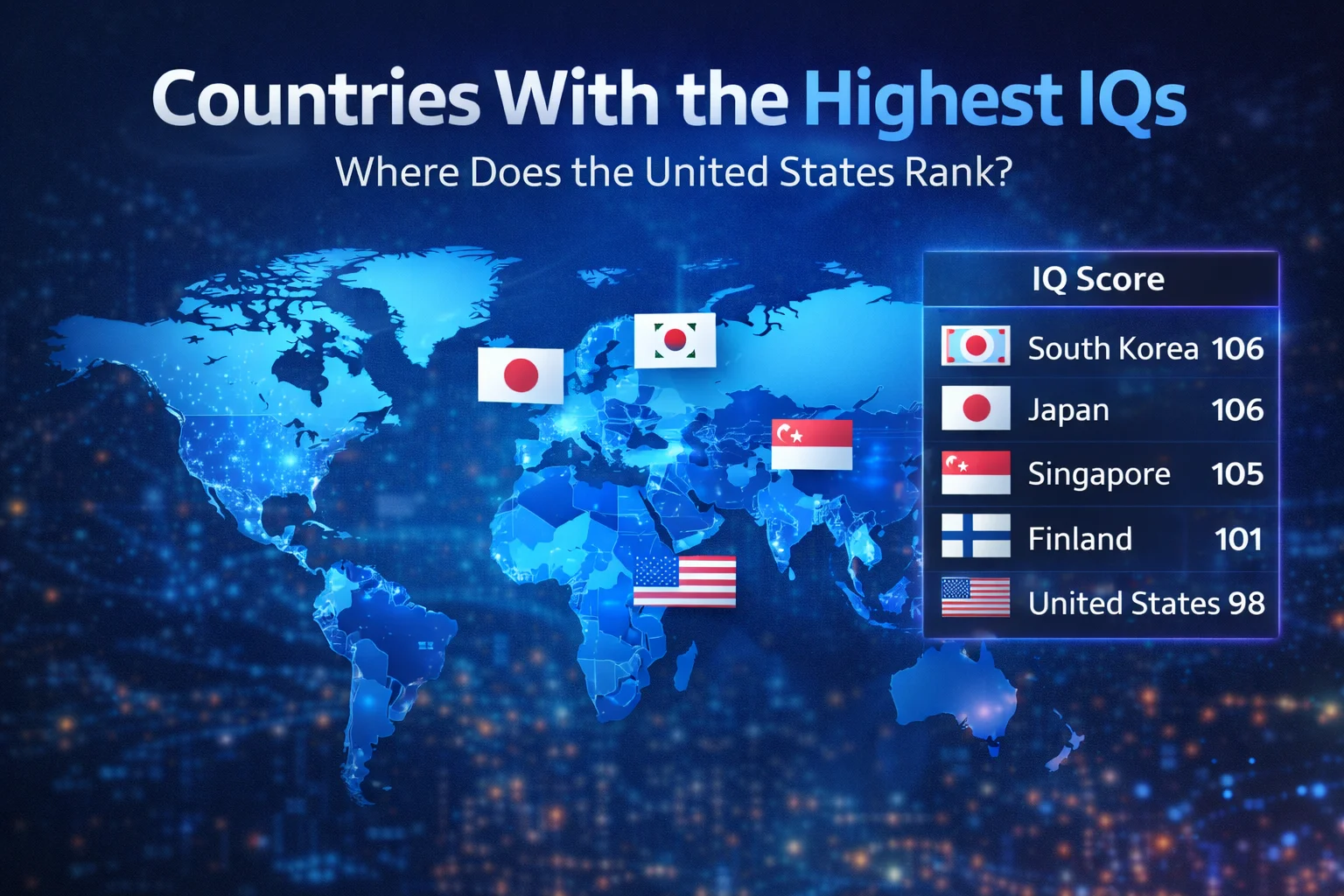
Countries With the Highest IQs
Discussions about intelligence often spark curiosity, debate, and sometimes controversy. One question that frequently appears in global search trends is: Which countries have the highest IQs, and where does the United States rank?
While intelligence cannot be reduced to a single number, average national IQ scores are commonly used in academic and comparative research to explore patterns related to education, economic development, health, and social systems. These rankings are not definitive judgments of individuals but rather statistical averages drawn from standardized testing and large-scale studies.
This article explores:
-
-
-
How national IQ rankings are calculated
-
Which countries are typically ranked highest
-
Where the United States generally places
-
The factors that influence national IQ averages
-
The limitations of IQ comparisons
-
-
Countries With the Highest IQs
What Is IQ?
IQ, or Intelligence Quotient, is a score derived from standardized tests designed to measure certain cognitive abilities, such as:
-
Logical reasoning
-
Pattern recognition
-
Memory
-
Verbal and mathematical skills
National IQ rankings are usually compiled by:
-
Aggregating results from multiple standardized tests
-
Adjusting data for sample size and test variation
-
Comparing averages across populations
Important Context
It is essential to understand that:
-
IQ tests do not measure creativity, emotional intelligence, or cultural knowledge
-
Results can be influenced by education systems, nutrition, healthcare, and test familiarity
-
Rankings reflect averages, not individual intelligence
Countries Commonly Ranked With the Highest Average IQs
Although rankings vary slightly depending on methodology and data sources, several countries consistently appear near the top of global IQ lists.
1. East Asian Countries
Countries such as Japan, South Korea, Singapore, and China often rank highly. Contributing factors include:
-
Strong emphasis on education
-
High academic standards
-
Cultural focus on discipline and learning
-
Broad access to early childhood education
2. Northern and Western Europe
Nations like Finland, Germany, the Netherlands, Switzerland, and Sweden are also frequently near the top. These countries benefit from:
-
Well-funded public education systems
-
High literacy rates
-
Strong social support structures
-
Low levels of childhood malnutrition
3. Other High-Performing Regions
Some countries in Eastern Europe and parts of Central Europe also perform well in international cognitive assessments, often linked to:
-
Rigorous math and science education
-
Strong teacher training programs

Where Does the United States Rank?
The United States typically ranks in the upper-middle range globally when it comes to average IQ scores.
General Placement
-
Usually outside the top 10
-
Often ranked between 15th and 30th, depending on the study
-
Still above the global average
Why the Ranking Varies
The U.S. is unique in several ways:
-
Highly diverse population
-
Wide variation in education quality by region
-
Large socioeconomic differences
-
Immigration from countries with varied educational backgrounds
These factors create a broader distribution of scores, which can lower the national average compared to smaller, more homogeneous countries.
Factors That Influence National IQ Averages
1. Education Systems
Quality, accessibility, and consistency of education play a major role. Countries with:
-
Standardized national curricula
-
Strong teacher training
-
Early childhood education
tend to score higher on average.
2. Nutrition and Health
Childhood nutrition directly affects cognitive development. Nations with:
-
Low malnutrition rates
-
Universal healthcare access
often see higher average cognitive test results.
3. Socioeconomic Stability
Stable societies with:
-
Lower poverty rates
-
Reduced income inequality
provide environments more conducive to learning and development.
4. Cultural Attitudes Toward Learning
Cultural values emphasizing academic achievement, discipline, and long-term planning can influence outcomes.
Why IQ Rankings Are Often Misunderstood
IQ Is Not the Same as Intelligence
Intelligence is multi-dimensional. IQ tests focus on specific cognitive skills but do not measure:
-
Creativity
-
Emotional intelligence
-
Leadership ability
-
Practical problem-solving
Environmental Factors Matter
Differences in:
-
Test language
-
Educational access
-
Cultural familiarity with testing
can significantly affect results.
Averages Hide Individual Variation
Every country has individuals across the full intelligence spectrum. National averages do not define personal ability.
Countries with high immigration, including the United States, Canada, and Australia, often show wider IQ distributions. This reflects:
-
Different educational backgrounds
-
Language differences
-
Varying access to early education
Over time, access to education and integration often reduce these gaps.
IQ Rankings and Economic Development
Research shows a correlation (not causation) between:
-
Average IQ scores
-
Economic productivity
-
Innovation capacity
However, economic success also depends on:
-
Institutions
-
Governance
-
Infrastructure
-
Social stability
Many countries with moderate IQ averages perform exceptionally well due to strong institutions and innovation ecosystems.
❓ Are IQ rankings scientifically reliable?
They are useful for broad comparisons but should be interpreted cautiously due to cultural and methodological limitations.
❓ Does a higher national IQ mean a country is “smarter”?
No. It reflects average test performance, not overall intelligence, creativity, or potential.
❓ Why isn’t the United States in the top 10?
Diversity, inequality in education quality, and socioeconomic variation affect national averages.
❓ Can a country’s average IQ change over time?
Yes. Improvements in education, healthcare, and nutrition can raise average scores over generations.
❓ Do IQ scores predict success?
They correlate with some academic outcomes but do not determine individual or national success on their own.
Conclusion
When examining countries with the highest IQs, it becomes clear that rankings reflect complex social, educational, and economic factors, not innate national intelligence.
The United States, while not at the very top of global IQ rankings, remains above the global average and continues to lead in innovation, research, and higher education. IQ data is best understood as one lens among many for analyzing global development—not a definitive measure of human potential.
Understanding these rankings responsibly helps move the conversation away from stereotypes and toward education, opportunity, and long-term investment in human capital.