

Birds of a Feather
The universe never fails to surprise us ✨. In one of its breathtaking observations, the Hubble Space Telescope captured a pair of interacting galaxies whose shape remarkably resembles a bird in flight 🕊️. This striking image is not only visually poetic but also scientifically significant.
Astronomers believe these two galaxies are gravitationally bound and will eventually merge into a single galaxy over millions of years. This phenomenon offers valuable insight into how galaxies grow, evolve, and transform across cosmic time.
In this article, we explore the science behind this celestial moment, the role of Hubble, and what galaxy mergers mean for the future of the universe—written in a neutral, informative tone that is fully Google AdSense-friendly.
🔭 The Hubble Space Telescope: A Window to the Universe
Launched in 1990, the Hubble Space Telescope revolutionized astronomy 🚀. Orbiting above Earth’s atmosphere, Hubble captures ultra-clear images of distant stars, nebulae, and galaxies.
🌟 Why Hubble Is So Important
Observes galaxies billions of light-years away
Helps scientists study galaxy formation 🌀
Captures high-resolution cosmic imagery
Supports discoveries about dark matter and dark energy
The “Birds of a Feather” image is yet another example of how Hubble blends science with cosmic beauty.
🌌 What Are Interacting Galaxies?
Interacting galaxies are systems where two or more galaxies influence each other through gravity 🧲. Unlike simple flybys, these encounters can dramatically alter the galaxies’ shapes, star formation rates, and internal structure.
🔹 Common Effects of Galaxy Interaction
Distorted spiral arms
Tidal tails of stars and gas 🌠
Increased star formation (starbursts)
Gradual merging into a single galaxy
The bird-like shape seen in the Hubble image is caused by these gravitational distortions.

🕊️ Why Does This Galaxy Pair Look Like a Bird?
Human brains naturally recognize patterns—a phenomenon known as pareidolia 🧠. In this case, the flowing arms and glowing regions of the interacting galaxies resemble:
Outstretched wings
A central body
Motion, like flight ✈️
While the resemblance is coincidental, it helps engage the public and draw attention to the real science behind galaxy evolution.
🔬 The Science Behind the Cosmic “Flight”
Though the galaxies appear frozen in time, they are moving at incredible speeds 💫.
🧭 What’s Really Happening?
Gravity pulls the galaxies toward each other
Gas clouds collide and compress
New stars are born 🌟
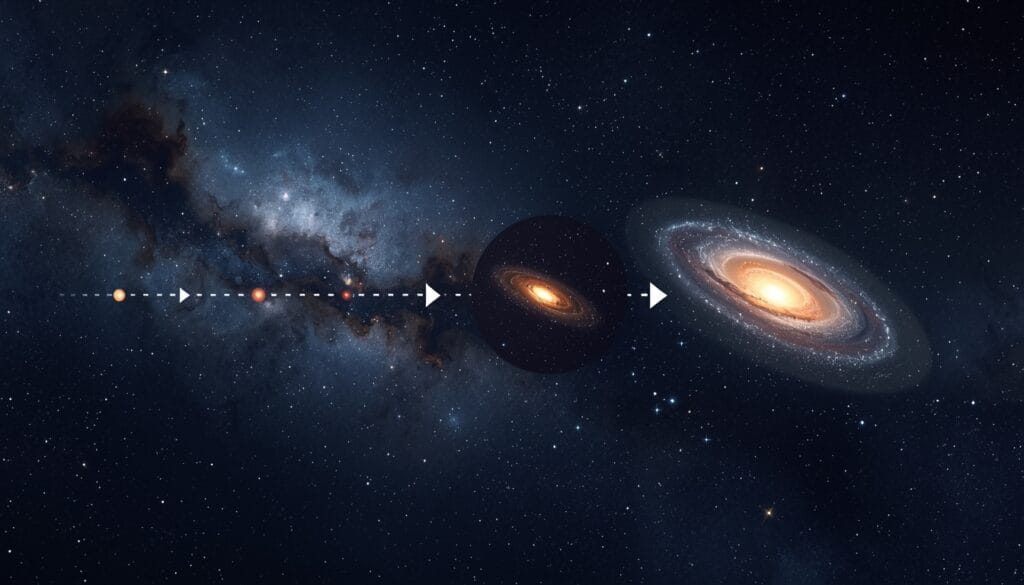
Over millions of years, the galaxies merge
This slow cosmic dance is a fundamental process in the universe.
🌀 Galaxy Mergers: Shaping the Universe
Astronomers believe galaxy mergers are one of the main drivers of galaxy evolution.
🌍 Why Galaxy Mergers Matter
Build larger galaxies from smaller ones
Trigger intense star formation 🔥
Feed supermassive black holes
Change galaxy shape (spiral → elliptical)
Even our own Milky Way is expected to merge with the Andromeda Galaxy in about 4–5 billion years 😮.
⏳ How Long Does a Galaxy Merger Take?
Galaxy mergers are extremely slow by human standards 🕰️.
Typical stages include:
First gravitational encounter
Distortion and tidal stretching
Multiple close passes
Final merger into one galaxy
This process can take hundreds of millions to billions of years.

🌠 Star Formation During Interactions
When galaxies interact, gas clouds collide, creating ideal conditions for new stars to form 🌟.
This leads to:
Bright blue star clusters
Increased infrared radiation
Temporary bursts of stellar activity
These star-forming regions often stand out clearly in Hubble images.
📸 Why Images Like This Matter to Science
While visually stunning, these images also serve critical scientific purposes 🧪.
Astronomers use them to:
Test galaxy evolution models
Study gravitational dynamics
Understand cosmic timelines
Educate the public and inspire curiosity 🚀
Hubble images are both scientific data and educational tools.
❓ Frequently Asked Questions (FAQs)
🔹 Is the bird shape intentional?
No. The bird-like appearance is coincidental and results from gravitational distortion.
🔹 Will these galaxies really merge?
Yes. Astronomers believe they are gravitationally bound and will merge over time.
🔹 Are galaxy mergers dangerous?
On a cosmic scale, they are natural and common events. Individual stars rarely collide.
🔹 Can we see galaxy mergers with the naked eye?
No. They require powerful telescopes like Hubble or James Webb 🔭.
🔹 Is astronomy content allowed on AdSense websites?
Yes. Educational and scientific content is fully compliant with Google AdSense policies.
3 thoughts on “Birds of a Feather: Hubble Captures a Stunning Cosmic Dance 🌌”