

A day that rattled markets, politics, and global commodities
Financial markets thrive on certainty, or at least on well‑telegraphed uncertainty. On this particular day in London, investors got neither. What began as a routine monetary policy announcement from the Bank of England (BoE) quickly snowballed into a far broader story — one that mixed fragile economic confidence, unexpected political controversy, and the dramatic collapse of merger talks that could have reshaped the global mining industry.
The BoE’s decision to hold interest rates might normally have been filed away as a non‑event. Instead, it landed alongside remarks from Governor Andrew Bailey expressing surprise — even shock — at political revelations involving Peter Mandelson, while news broke that long‑rumoured merger talks between mining giants Rio Tinto and Glencore had once again fallen apart.
Together, these threads painted a vivid picture of a world economy still searching for balance: inflation is easing but growth remains weak, politics continues to intrude into market confidence, and corporate ambition is colliding with shareholder reality. This blog unpacks what happened, why it mattered, and what it may signal for the months ahead.
The Bank of England stands pat — but sends a signal
The headline decision was simple enough. The Bank of England kept its benchmark interest rate unchanged, opting for continuity rather than a dramatic pivot. Yet beneath that surface calm lay a decision far more finely balanced than markets had expected.
The Monetary Policy Committee (MPC) vote was close, revealing a deepening divide over how soon the Bank should begin easing monetary policy. Some policymakers argued that inflation has cooled sufficiently to justify cutting rates sooner rather than later. Others warned that moving too fast could reignite price pressures or undermine credibility just as inflation expectations are stabilising.
This split mattered. Central banks communicate as much through nuance as through numbers, and a narrow vote is often interpreted as a warning shot. Investors quickly concluded that the era of high rates is nearing its end, even if the first cut does not arrive immediately.
Governor Andrew Bailey reinforced that interpretation. While stressing the need for caution, he acknowledged that inflation is moving closer to target and that the direction of travel for interest rates is now more likely downward than upward. For households and businesses battered by years of rising borrowing costs, the message was clear: relief is not here yet, but it is coming into view.
Markets react: relief, nerves, and a weaker pound
Financial markets wasted little time in responding. UK bank shares slipped as investors began pricing in lower future interest margins. The pound weakened, reflecting expectations that UK rates may fall faster than those in some other major economies. Government bond yields edged down as traders adjusted their outlook for monetary policy over the rest of the year.
This reaction highlighted a recurring tension for central banks. What is good news for borrowers — the prospect of cheaper credit — is often bad news for lenders and for a currency’s perceived strength. The BoE’s challenge is to navigate this transition without triggering unnecessary volatility.
At the same time, the broader market mood remained fragile. Global investors are acutely sensitive to signs that economic growth is slowing faster than policymakers anticipate. The BoE’s own downgraded growth outlook did little to reassure those already worried about stagnation in the UK economy.
A political curveball: Bailey’s ‘shock’ over Mandelson
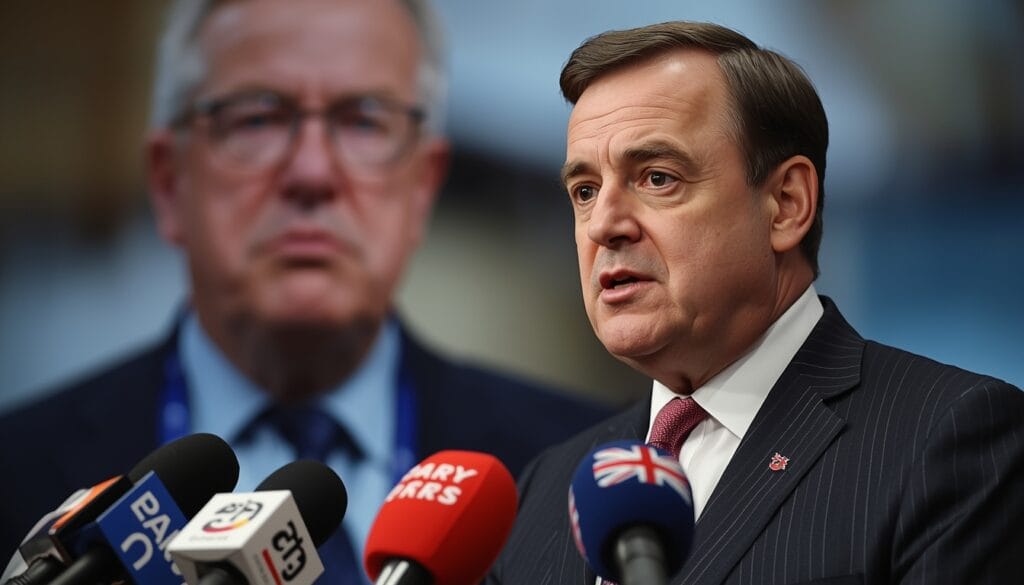
If the rate decision set the economic tone, politics provided the day’s most unexpected headline. Governor Bailey’s remarks expressing shock over revelations connected to Peter Mandelson injected a distinctly human element into what is usually a technocratic process.
While careful not to stray into partisan commentary, Bailey emphasised the importance of transparency, trust, and ethical standards in public life. His comments were widely interpreted as reflecting broader unease within the establishment about the resurfacing of past actions and communications, particularly at a time when public confidence in institutions remains fragile.
For markets, the significance lay less in the details of the controversy and more in the signal it sent. Investors prefer clear lines between politics and monetary policy. Any hint that political turbulence might distract from or complicate economic decision‑making is enough to raise eyebrows.
The timing was especially sensitive. With the UK economy struggling to regain momentum and households still feeling the pinch of higher living costs, political distractions risk undermining already‑shaky confidence. Bailey’s unusually candid tone suggested that even the Bank — traditionally cautious in its language — felt compelled to acknowledge the wider context.
The Rio‑Glencore saga: a merger that never was
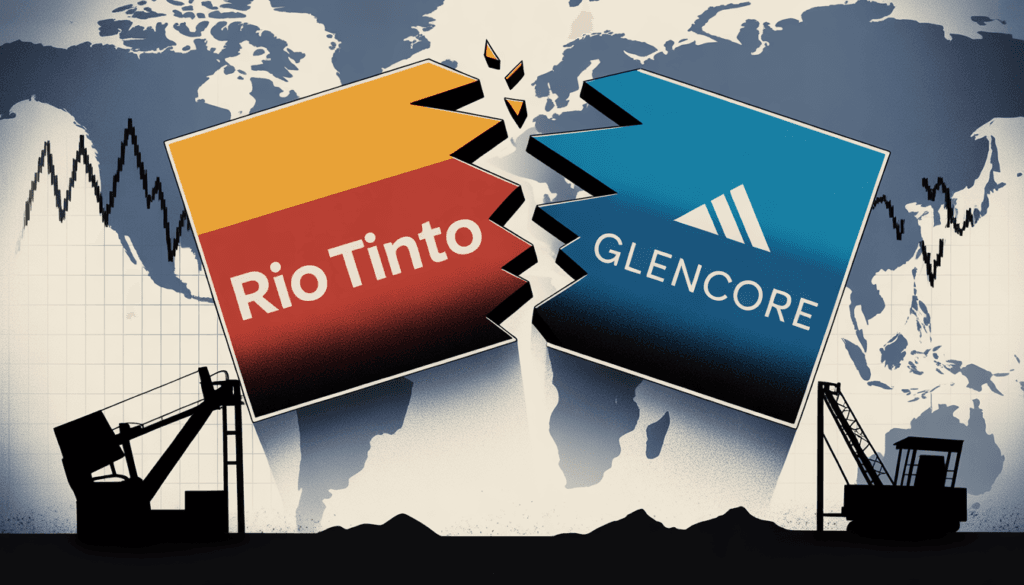
While attention in the morning focused on rates and politics, the corporate world delivered its own bombshell. Rio Tinto confirmed that merger talks with Glencore had collapsed, ending — at least for now — one of the most ambitious deal concepts in the mining sector.
The logic behind the proposed tie‑up was clear. A combined Rio‑Glencore entity would have created a mining behemoth with unparalleled scale across iron ore, copper, and other critical commodities. In an era defined by the energy transition and the race for resources needed for electrification, such scale is immensely attractive.
Yet the obstacles were equally formidable. Valuation disagreements, regulatory hurdles, and concerns about debt and asset quality repeatedly derailed discussions. Shareholders, particularly at Rio Tinto, have long been wary of absorbing Glencore’s more complex and leveraged structure.
This latest collapse confirmed what many suspected: strategic logic alone is not enough. In today’s market environment, investors are demanding discipline, simplicity, and clear returns. Mega‑mergers that promise long‑term dominance but carry short‑term risk face intense scrutiny.
Market fallout from the collapsed talks
The immediate reaction was brutal. Glencore’s shares fell sharply as investors recalibrated expectations that had quietly built up around the possibility of a deal. Rio Tinto’s stock also slipped, though less dramatically, reflecting relief for some shareholders that the company would not pursue a transaction perceived as risky.
Beyond the share prices, the episode sent a broader message to the resources sector. Consolidation may make sense on paper, especially as mining companies seek scale to fund decarbonisation and new projects. But the tolerance for transformational deals is low when commodity prices are volatile and capital is no longer cheap.
The collapse also underscored how different corporate cultures can be just as important as balance sheets. Rio Tinto’s traditionally conservative approach has long contrasted with Glencore’s more aggressive trading‑driven model. Bridging that gap may simply be too difficult in practice.
Europe and the global backdrop
The UK’s developments did not occur in isolation. Across Europe, central banks are grappling with similar dilemmas: inflation is easing, but growth remains stubbornly weak. Policymakers must decide when to pivot from fighting inflation to supporting expansion without reigniting price pressures.
In this context, the BoE’s stance looks broadly aligned with its peers. Holding rates steady while opening the door to future cuts allows flexibility. Yet coordination is imperfect, and diverging economic conditions mean that timing will vary from country to country.
Global equity markets reflected this uncertainty. Risk appetite remains fragile, with investors oscillating between optimism about lower rates and concern about slowing demand. Commodity markets, meanwhile, are being pulled in opposite directions by weaker growth prospects and long‑term structural demand tied to the energy transition.
What this means for households and businesses
Taken together, the day’s events captured the uneasy mood of the global economy. Central banks are edging toward a turning point but remain wary. Politics continues to intrude in unexpected ways. Corporate giants are reassessing how bold they can afford to be.
The Bank of England’s decision to hold rates was not a surprise, but the narrowness of the vote spoke volumes. Andrew Bailey’s remarks on political ethics revealed an institution conscious of its place in a broader societal landscape. The collapse of the Rio‑Glencore talks reminded investors that even the most compelling strategic visions can falter when reality intervenes.
As the year unfolds, these themes are likely to persist. Rate cuts may come, but they will not solve structural growth challenges overnight. Political controversies will continue to test confidence. And boardrooms will remain cautious, balancing ambition against a market that is quick to punish missteps.
In that sense, this was more than just a busy news day. It was a snapshot of an economy — and a world — still searching for stability in the aftermath of extraordinary change.
❓ Frequently Asked Questions (FAQs)
1. Why did the Bank of England hold interest rates?
The Bank of England held interest rates because inflation is easing but remains above the long-term comfort zone. Policymakers want clearer evidence that price pressures are sustainably under control before cutting rates, especially given weak economic growth and lingering global uncertainty.
2. When is the Bank of England expected to cut interest rates?
Most economists expect the Bank of England to begin cutting interest rates later in 2026 if inflation continues to fall toward the 2% target. The narrow vote split within the Monetary Policy Committee suggests rate cuts are getting closer, though timing will depend on economic data.
3. How did markets react to the Bank of England’s decision?
UK markets reacted cautiously. Bank shares fell on expectations of lower future profits, the pound weakened against major currencies, and government bond yields declined as investors priced in possible rate cuts later in the year.
4. Why did Andrew Bailey say he was “shocked” over Peter Mandelson?
Andrew Bailey said he was “shocked” following revelations linked to Peter Mandelson that raised concerns about transparency and ethical standards. While not directly tied to monetary policy, the comments highlighted political sensitivities that can influence market confidence.
5. What happened to the Rio Tinto and Glencore merger talks?
Rio Tinto and Glencore ended merger discussions after failing to agree on valuation and deal structure. Shareholder concerns, regulatory risks, and differences in corporate culture played a major role in the collapse of talks.