
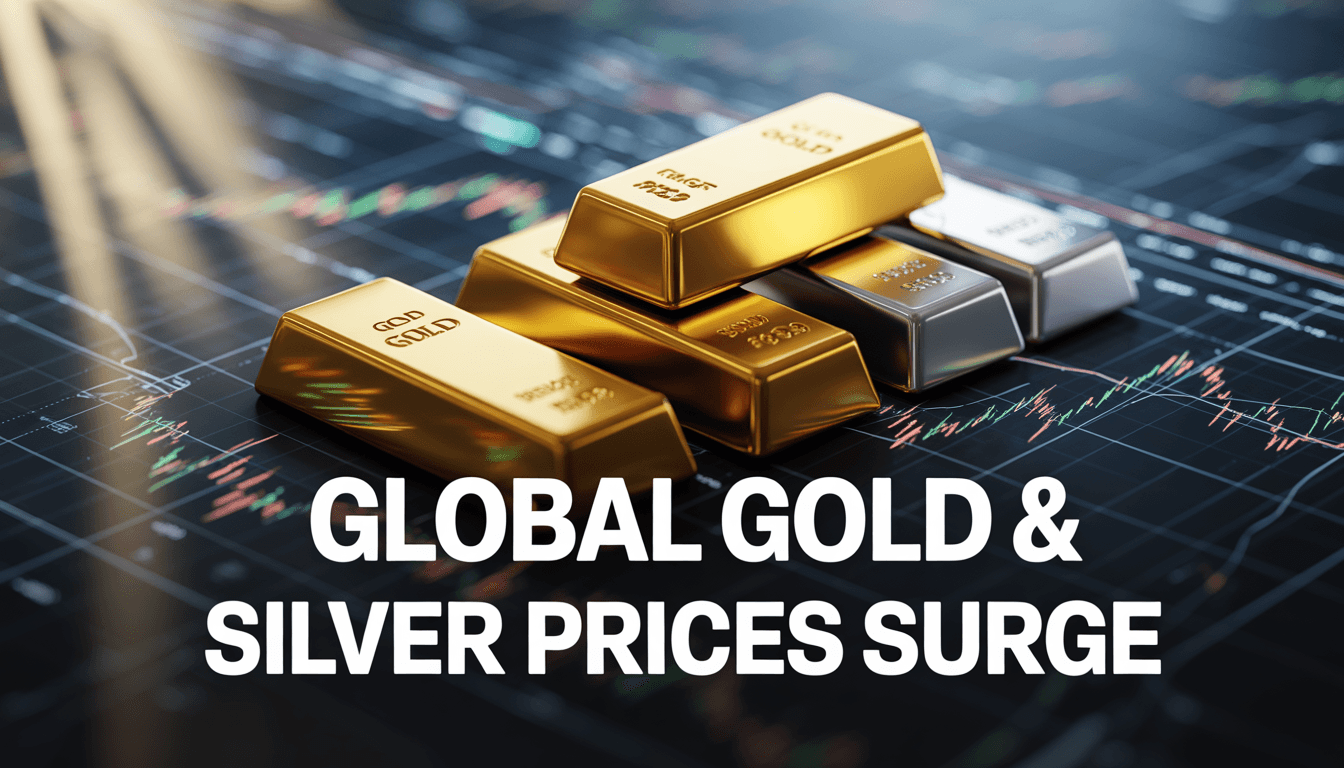
💰 Gold and silver prices are once again dominating global financial headlines as investors react to economic uncertainty, shifting central bank policies, and rising geopolitical tensions. Precious metals—long viewed as safe-haven assets—are experiencing renewed interest, but growing volatility is making market participants cautious.
This latest movement in global gold and silver prices reflects deeper concerns about inflation, currency stability, and the future direction of global growth 🌍.
📈 Why Gold and Silver Prices Are Making Headlines Today
The precious metals market has entered a critical phase. Investors across Asia, Europe, and North America are closely monitoring gold and silver as signals emerge from central banks and economic data releases.
Key drivers include:
🔥 Persistent inflation pressure
🏦 Uncertain interest rate outlooks
🌐 Geopolitical instability
📉 Currency fluctuations
Gold, often seen as a hedge against inflation, has attracted strong demand, while silver—known for both investment and industrial use—has shown sharper price swings.
🏦 Central Banks Play a Crucial Role
Central bank policy remains one of the most powerful forces shaping global gold and silver prices.
Many central banks continue to reassess their monetary strategies as economies struggle to balance inflation control with growth support. Even subtle hints about future interest rate changes can trigger sharp reactions in precious metals markets.
✨ Lower interest rate expectations generally support gold and silver prices by reducing the opportunity cost of holding non-yielding assets.
🌍 Global Economic Uncertainty Fuels Safe-Haven Demand
Economic uncertainty is not confined to one region—it is global.
Slowing growth in major economies
Trade tensions between global powers
Ongoing geopolitical conflicts
These factors push investors toward assets perceived as stable over time. Gold, in particular, benefits during periods of market stress, while silver often amplifies price movements due to its dual role as a monetary and industrial metal ⚙️.
🏭 Silver’s Industrial Demand Adds Complexity
Unlike gold, silver is heavily used in industries such as:
Renewable energy (solar panels ☀️)
Electronics and semiconductors
Medical and automotive sectors
This makes silver prices more sensitive to economic cycles. When industrial demand weakens, silver can fall faster than gold—but during economic recoveries, it often outperforms.
📊 This dual nature keeps silver prices volatile and attractive to short-term traders.
💱 Currency Movements Impact Precious Metals
Gold and silver are typically priced in US dollars, making currency fluctuations a critical factor.
📉 A weaker dollar tends to lift gold and silver prices
📈 A stronger dollar can pressure prices downward
As global investors reassess currency risks, precious metals often become an alternative store of value.

📉 Volatility Keeps Investors Cautious
Despite bullish sentiment, volatility remains a major concern ⚠️.
Rapid price swings have led analysts to warn investors against assuming a straight upward path. Short-term corrections are common, especially when markets react to unexpected economic data or policy statements.
📌 Long-term investors often view pullbacks as buying opportunities, while short-term traders face higher risks.
🧠 Investor Sentiment: Opportunity vs Risk
Investor sentiment around gold and silver is divided:
✅ Optimists believe inflation, debt, and uncertainty will continue supporting prices
⚠️ Skeptics warn that tightening financial conditions could limit gains
This push-and-pull dynamic is keeping markets highly reactive to news.
🌐 Regional Market Highlights
Asia
Strong cultural demand and central bank interest continue to support gold consumption, especially during periods of currency volatility.
Europe
Economic uncertainty and energy concerns have increased interest in gold as a protective asset.
North America
Institutional investors and ETFs play a major role in price movements, responding quickly to economic signals.
🔮 What Analysts Are Watching Next
Market analysts are closely monitoring:
Upcoming inflation reports 📊
Central bank policy meetings 🏦
Global growth forecasts 🌍
Geopolitical developments ⚔️
Any surprise in these areas could trigger sharp moves in global gold and silver prices.
🏆 Gold vs Silver: Which Is Performing Better?
Gold continues to act as a stability anchor, while silver offers higher potential returns—but with increased risk.
💡 Many diversified investors choose to hold both metals to balance safety and growth potential.
🧭 Outlook: Where Do Gold and Silver Go From Here?
While short-term volatility is likely, the long-term outlook for precious metals remains closely tied to economic stability and policy decisions.
Gold and silver are expected to remain key assets for investors seeking diversification and protection against uncertainty.
🧠 Final Thoughts
💬 Global gold and silver prices are reflecting a world in transition—caught between inflation fears, economic recovery hopes, and geopolitical risks. While opportunities exist, volatility demands caution.
For investors, staying informed and diversified remains the smartest strategy.
❓ FREQUENTLY ASKED QUESTIONS
Q1: Why are global gold and silver prices rising?
Rising inflation concerns, economic uncertainty, and central bank signals are increasing demand for safe-haven assets.
Q2: Is silver more volatile than gold?
Yes. Silver’s industrial demand makes it more sensitive to economic cycles, causing sharper price swings.
Q3: How do interest rates affect gold prices?
Lower interest rates usually support gold prices by reducing the cost of holding non-yielding assets.
Q4: Should investors buy gold during volatile markets?
Gold is often used as a hedge, but investors should consider their risk tolerance and investment horizon.
Q5: Can currency movements impact precious metals?
Yes. A weaker US dollar generally boosts gold and silver prices, while a stronger dollar can pressure them.
1 thought on “🚨 BREAKING NEWS: GLOBAL GOLD AND SILVER PRICES IN FOCUS”