Introduction: The Age of Unregulated AI Is Ending 🚨
Global AI Regulations : Artificial intelligence is no longer a futuristic concept—it is already reshaping economies, politics, security, and everyday life. From automated hiring systems to facial recognition, generative content, and autonomous weapons research, AI has moved faster than laws can keep up.
Now, that gap is closing.
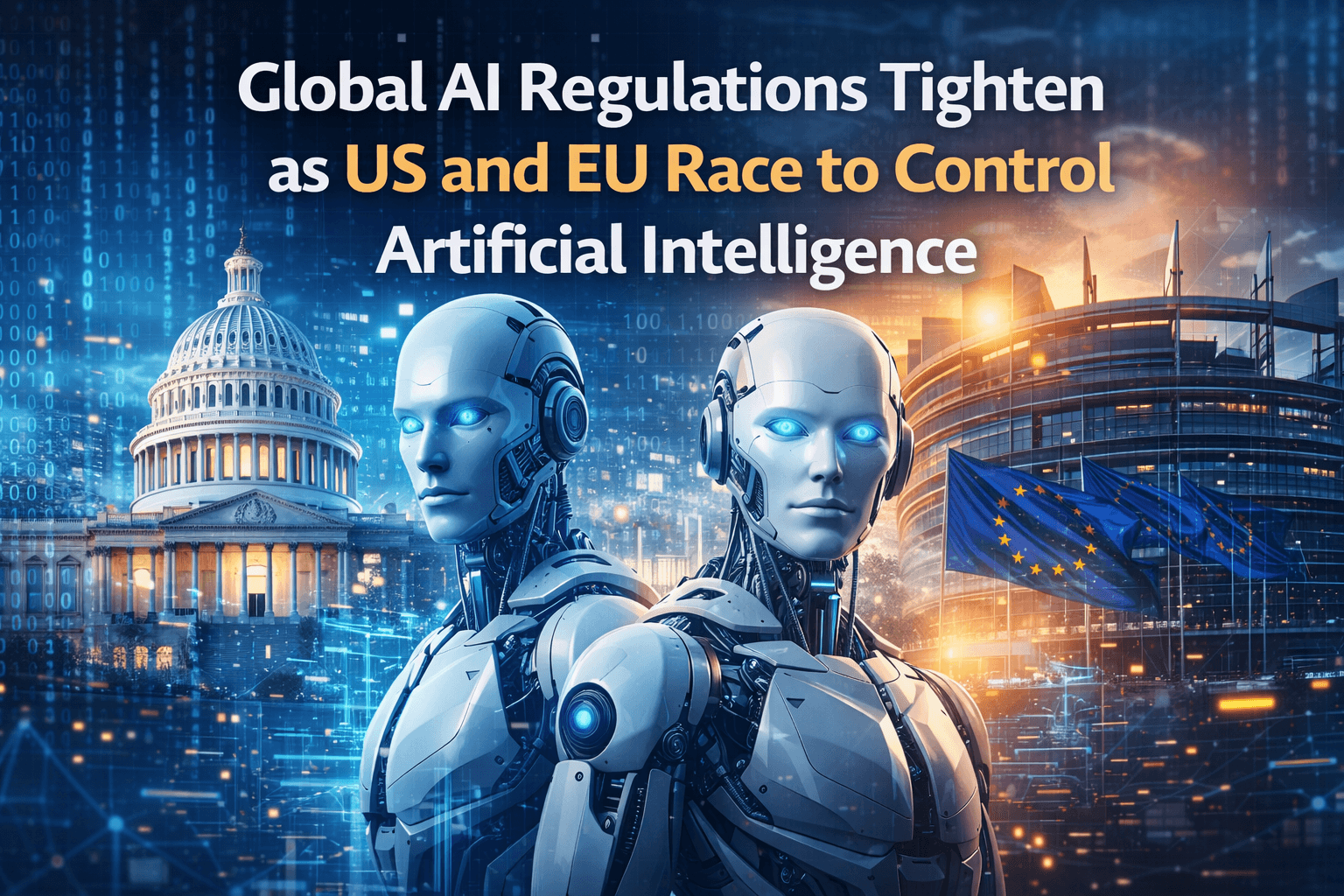
In 2026, governments around the world—led by the European Union and the United States—are racing to regulate artificial intelligence before it reshapes society in irreversible ways.
This global push marks a turning point: AI is no longer just a technology issue—it is a political, economic, and ethical battleground.
Why Governments Are Moving Fast on AI Regulation ⚖️
1. Explosive Growth of AI Capabilities
AI systems are now capable of:
-
Writing human-like text
-
Generating images and videos
-
Predicting behavior
-
Assisting military planning
-
Influencing elections and public opinion
What once required years of research can now be done by startups—or even individuals—with access to powerful models.
2. Rising Risks to Democracy and Privacy 🔐
Governments are increasingly concerned about:
-
Deepfake videos and election interference
-
Mass surveillance using facial recognition
-
Unauthorized data harvesting
-
AI-driven misinformation campaigns
Without regulation, experts warn AI could undermine trust in institutions and destabilize democratic systems.
The European Union’s AI Act: The World’s Strictest Framework 🇪🇺
The EU has positioned itself as the global leader in AI governance through its landmark AI Act, a sweeping legal framework that categorizes AI systems by risk.
How the EU AI Act Works
AI systems are divided into four categories:
🔴 Unacceptable Risk (Banned)
-
Social scoring systems
-
Mass biometric surveillance
-
AI that manipulates human behavior
🟠 High Risk (Strictly Regulated)
-
AI used in hiring and recruitment
-
Credit scoring systems
-
Medical and diagnostic AI
-
Law enforcement tools
🟡 Limited Risk
-
Chatbots and generative AI (must disclose AI use)
🟢 Minimal Risk
-
AI in gaming, filters, and basic tools
Penalties and Enforcement
Companies violating the AI Act can face fines of up to 7% of global revenue, making compliance unavoidable for tech giants.
The United States Approach: Innovation First, Safety Second 🇺🇸
Unlike the EU, the US has taken a more flexible, sector-based approach.
Key Elements of US AI Policy
-
Executive orders on AI safety and transparency
-
Voluntary commitments from major tech companies
-
Increased funding for AI research oversight
-
Focus on national security and military AI
US officials argue that overregulation could stifle innovation, especially as competition with China intensifies.
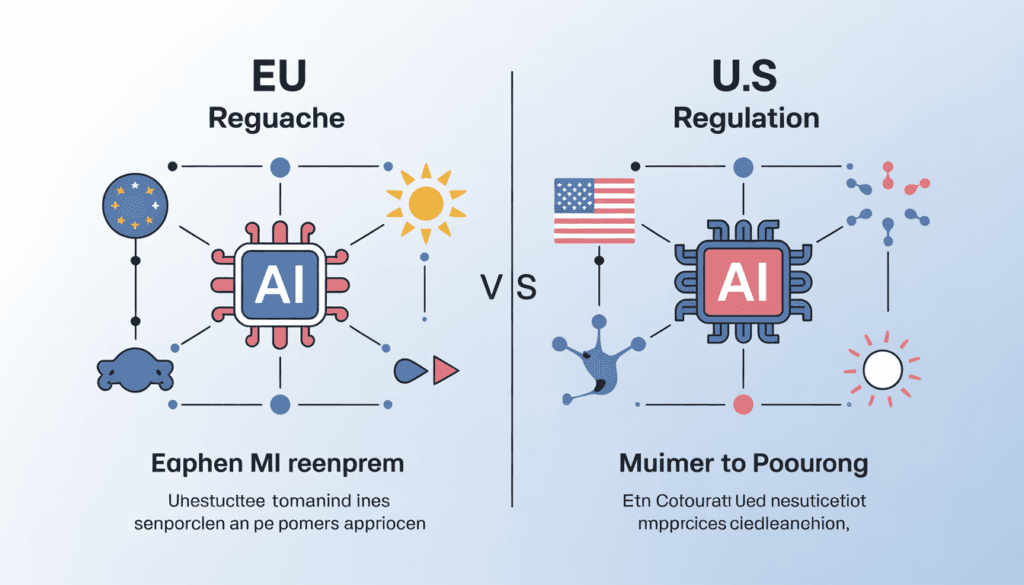
A Global Split: Two AI Regulatory Models 🌏
The world is increasingly dividing into two camps:
🟦 The EU Model
-
Strict rules
-
Human rights focus
-
Heavy enforcement
🟥 The US Model
-
Innovation-driven
-
Industry-led standards
-
National security focus
Countries in Asia, Africa, and Latin America are watching closely, with many expected to adopt one of these frameworks rather than create their own.

Economic Impact: Winners and Losers 💰
Big Tech Companies
-
Can afford compliance
-
Shape regulation through lobbying
-
Maintain market dominance
Startups and Small Businesses
-
Higher compliance costs
-
Legal uncertainty
-
Risk of being pushed out of the market
Consumers
-
Better transparency
-
More protection
-
Slower rollout of new AI tools
AI and Jobs: Regulation Meets Automation 👩💼👨💻
One of the most searched topics globally is “Will AI take my job?”
Regulators are now addressing:
-
AI-driven layoffs
-
Algorithmic bias in hiring
-
Worker surveillance systems
The EU AI Act explicitly restricts AI systems that evaluate employee emotions or behavior without consent.
National Security and Military AI 🛡️
AI regulation is also about power and defense.
Governments are deeply concerned about:
-
Autonomous weapons
-
AI-driven cyberattacks
-
Surveillance systems
-
Battlefield decision-making
While civilian AI is regulated, military AI remains largely classified, raising ethical concerns among human rights organizations.
AI, Free Speech, and Content Moderation 🗣️
Generative AI has transformed content creation—but also misinformation.
New regulations require:
-
Clear labeling of AI-generated content
-
Disclosure when users interact with AI
-
Safeguards against political manipulation
This is especially critical ahead of major elections worldwide.
Public Reaction: Support, Fear, and Confusion 😕👍
Public opinion is divided:
-
Many welcome stronger protections
-
Others fear censorship and surveillance
-
Businesses worry about innovation slowdowns
Polls show a growing demand for AI transparency and accountability, even among tech-savvy users.
What This Means for the Future of AI 🔮
Experts predict that by 2030:
-
AI regulation will be as standard as data protection laws
-
Companies will need “AI compliance officers”
-
Global treaties on AI safety may emerge
-
Ethical AI will become a competitive advantage
The race is no longer about building the smartest AI—but about controlling it responsibly.
Frequently Asked Questions (FAQs) ❓
What are global AI regulations?
They are laws and policies designed to control how artificial intelligence is developed, deployed, and used.
Why is the EU stricter than the US?
The EU prioritizes human rights and consumer protection, while the US prioritizes innovation and economic competitiveness.
Will AI regulation slow innovation?
Possibly in the short term, but supporters argue it builds long-term trust and sustainability.
Does AI regulation affect everyday users?
Yes. Users will see clearer labels, better data protection, and more transparency.
Which countries are leading AI regulation?
The European Union and the United States currently lead global efforts.
Conclusion: A Defining Moment for Artificial Intelligence 🌐
Artificial intelligence is reshaping humanity faster than any previous technology. As governments tighten regulations, the world stands at a crossroads.
The decisions made now—by lawmakers, businesses, and citizens—will determine whether AI becomes a force for progress or a source of instability.
One thing is clear: the era of unregulated AI is over.