
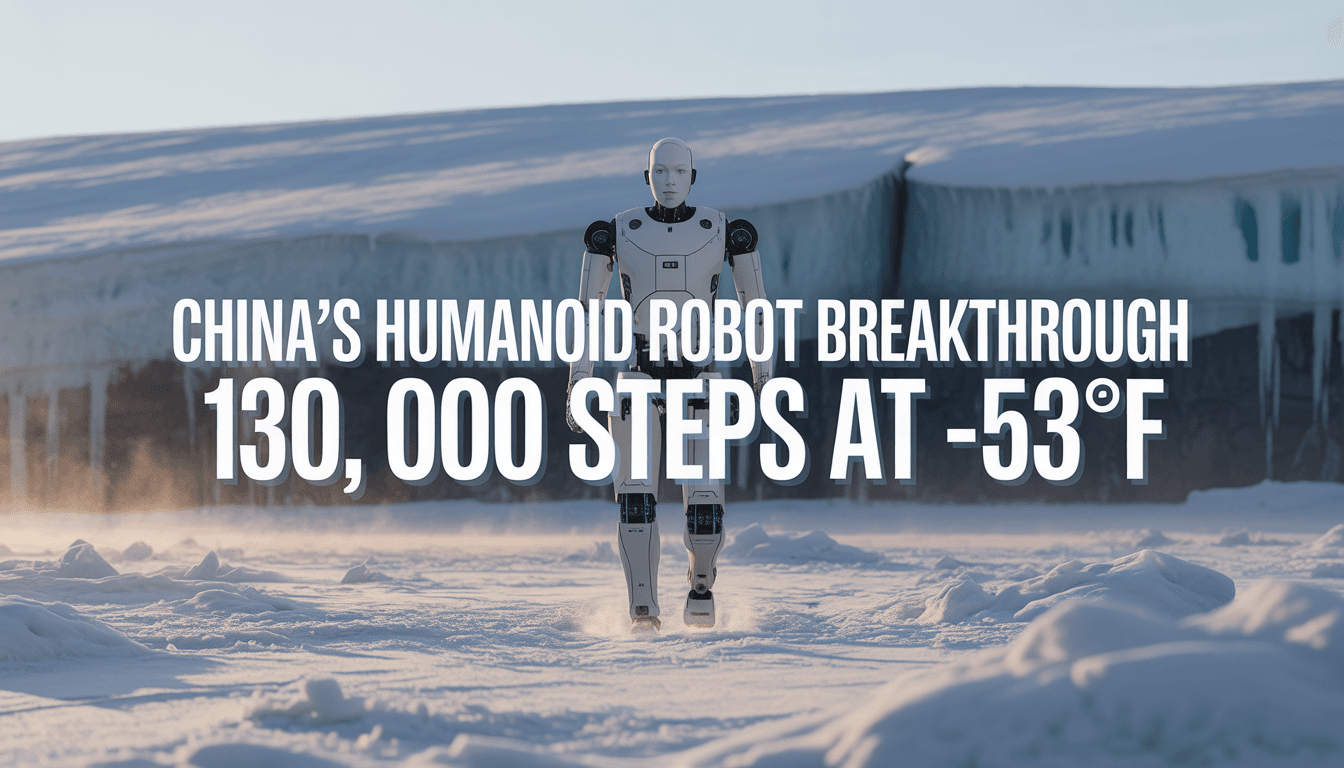
In a remarkable technological milestone, China has unveiled a humanoid robot capable of walking 130,000 steps in temperatures as low as -53°F (-47°C). This achievement marks a world first in robotics, demonstrating unprecedented durability, balance, and artificial intelligence performance under extreme environmental conditions 🌍.
Cold environments pose some of the toughest challenges for machines, especially humanoid robots that rely on precision motors, sensors, and computing systems. By successfully operating in such severe cold for an extended period, this Chinese-developed robot showcases how far robotics engineering, AI control systems, and materials science have advanced.
🧠 Why Extreme Cold Is a Major Challenge for Robots
Operating in subzero environments is exceptionally difficult for robotic systems ❄️.
⚠️ Key Cold-Weather Challenges
Battery performance drops sharply
Lubricants can freeze or thicken
Metal components become brittle
Sensors lose accuracy
Electronic circuits risk failure
For humanoid robots, which rely on complex joint movement and balance, these challenges are even more severe. Successfully completing 130,000 continuous steps under such conditions highlights a major leap in engineering resilience.
🚶♂️ What Makes This Achievement Historic?
This is not just about walking—it’s about sustained, stable, intelligent movement in an environment hostile to most machines.
🌟 Key Records Set
First humanoid robot to operate at -53°F
Longest continuous walking test in extreme cold
Demonstration of AI stability under harsh conditions
Breakthrough in cold-resistant robotics hardware
The test proves the robot can maintain balance, posture, and decision-making without human intervention for extended periods.

🏗️ Technology Behind the Robot’s Success
China’s humanoid robot integrates multiple advanced technologies designed specifically for harsh environments.
🤖 Advanced AI Motion Control
Artificial intelligence continuously adjusts gait, posture, and foot placement in real time, compensating for slippery and uneven surfaces.
🦵 Cold-Resistant Actuators
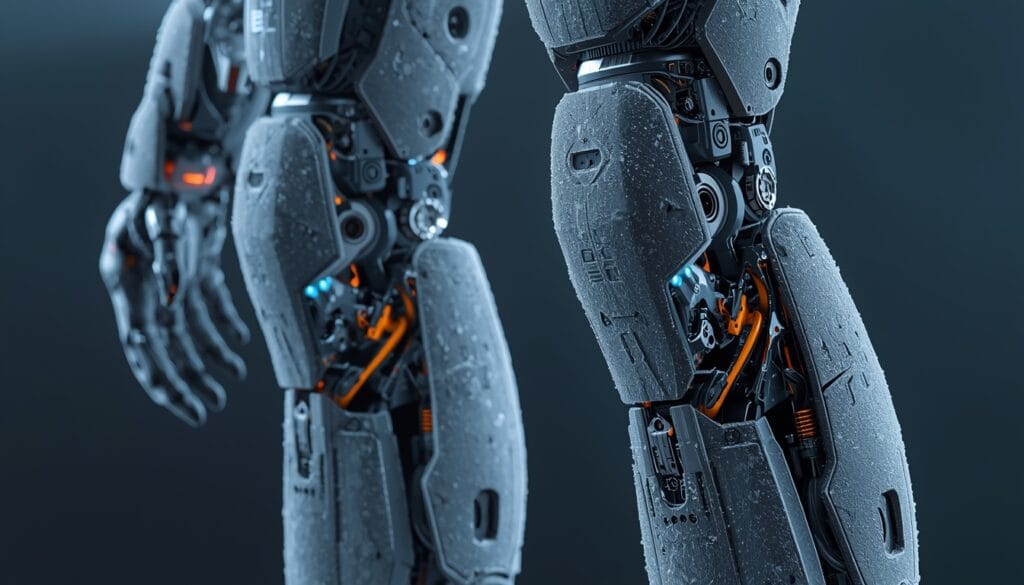
Specialized motors and joint systems are engineered to function smoothly even when temperatures drop far below freezing.
🔋 Thermal Battery Management
The robot uses insulated battery systems and internal thermal regulation to maintain optimal operating temperatures.
🧠 Smart Sensor Fusion
Multiple sensors—including force, temperature, and motion sensors—work together to ensure stability and responsiveness.
🇨🇳 China’s Growing Leadership in Humanoid Robotics
China has significantly increased investment in artificial intelligence, robotics, and automation over the past decade 🚀.
📈 Strategic Focus Areas
Humanoid robot development
Industrial and service robotics
AI-powered autonomous systems
Robotics applications in extreme environments
This achievement reflects China’s broader goal of becoming a global leader in next-generation robotics technologies.
🌍 Real-World Applications of Cold-Resistant Humanoid Robots
Robots capable of operating in extreme cold could transform several industries.
🧊 Polar & Arctic Research
Scientific data collection
Equipment maintenance
Reduced risk to human researchers
🚨 Disaster Response
Earthquake zones in cold regions
Search and rescue after blizzards
Infrastructure inspection
🛢️ Energy & Industrial Use
Oil and gas facilities
Remote pipeline inspection
Maintenance in freezing environments
🚀 Space & Planetary Exploration
Extreme cold robotics research also benefits future missions to:
The Moon
Mars
Icy moons like Europa
🔬 Testing Conditions: How the Robot Was Evaluated
The robot was tested in controlled extreme-cold environments designed to replicate real-world freezing conditions.
🧪 Test Parameters
Sustained -53°F temperature exposure
Continuous walking cycles
Stability and balance monitoring
Power consumption analysis
Hardware durability evaluation
Completing 130,000 steps under these conditions demonstrates exceptional system reliability.
🧠 AI Learning in Extreme Environments
One of the most impressive aspects is the robot’s ability to adapt and learn during operation.
🧩 Adaptive Intelligence Features
Gait optimization based on terrain feedback
Energy efficiency adjustments
Self-correction for balance shifts
Error detection and mitigation
This shows how AI systems are becoming more robust and context-aware.

⚖️ Challenges Still Facing Humanoid Robotics
Despite this success, humanoid robots still face limitations.
🔍 Ongoing Challenges
High development and production costs
Energy efficiency constraints
Complex maintenance requirements
Ethical and regulatory considerations
However, milestones like this help accelerate research and cost reduction over time.
🔮 The Future of Extreme-Environment Robotics
Experts believe this achievement represents a turning point.
🚀 What Comes Next?
Longer-duration tests
More complex task execution
Deployment in real-world cold regions
Integration with industrial systems
Humanoid robots may soon work alongside humans in environments once considered inaccessible.
❓ Frequently Asked Questions (FAQs)
🔹 What makes this humanoid robot special?
It is the first humanoid robot to walk 130,000 steps in temperatures as low as -53°F.
🔹 Why is cold-weather testing important?
Extreme cold environments challenge batteries, motors, and sensors, making successful operation a major engineering milestone.
🔹 What industries could benefit from this technology?
Arctic research, disaster response, energy infrastructure, and space exploration.
🔹 Is this robot autonomous?
Yes, it uses AI-driven motion control and sensor feedback to operate independently.
🔹 Is robotics content allowed on AdSense websites?
Yes. Educational and informational technology content complies with Google AdSense policies.
3 thoughts on “🤖❄️ China’s Humanoid Robot Becomes World’s First to Walk 130,000 Steps in -53°F”