
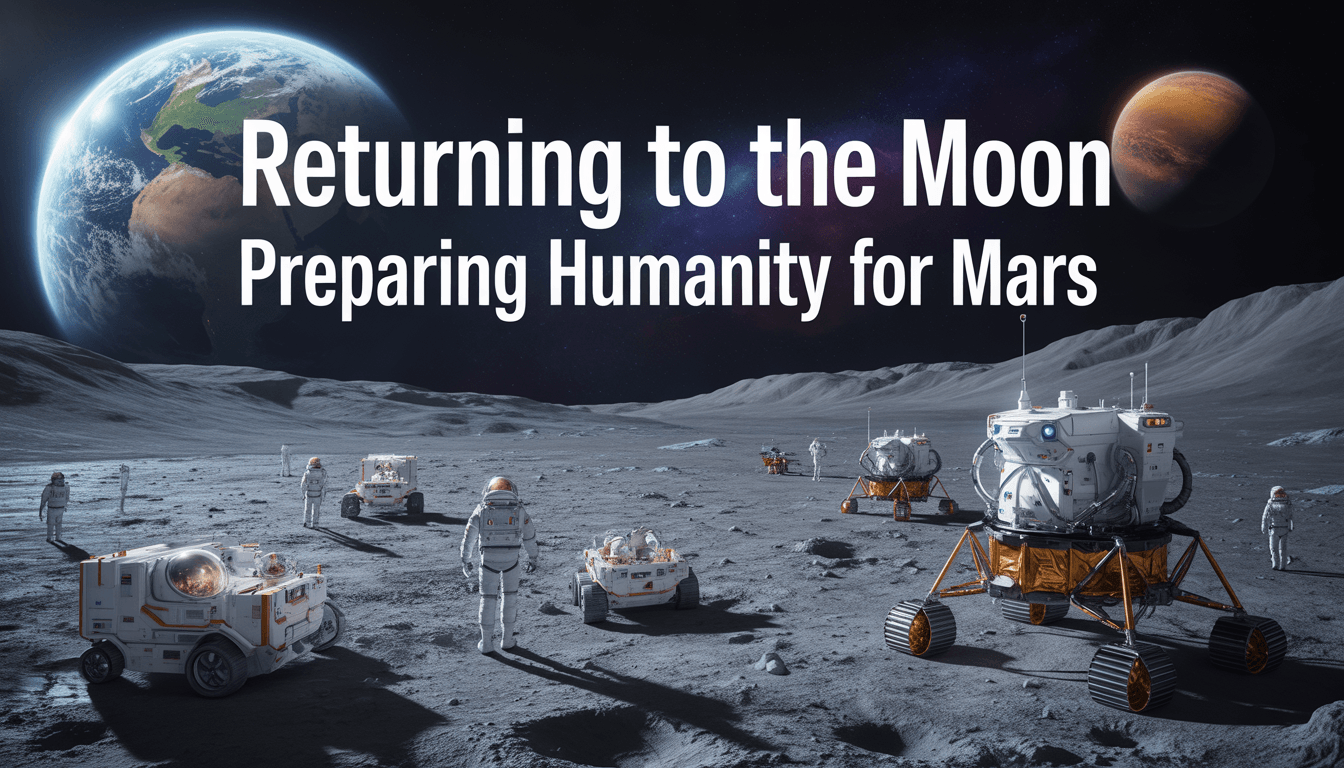
The idea of humans walking on Mars has long captured our imagination 🌌. While a crewed mission to the Red Planet is still years away, returning to the Moon is a critical stepping stone for space exploration. NASA’s Artemis program, along with international and private partnerships, aims to establish a sustainable human presence on the Moon by the late 2020s. This lunar experience will be key to developing the technology, knowledge, and strategies required to send humans safely to Mars.
🛰️ The Moon as a Testing Ground for Mars Missions
The Moon is only 384,400 km from Earth, making it a perfect testing ground for deep-space operations. Unlike Mars, which is over 225 million km away at closest approach, lunar missions allow astronauts and engineers to trial equipment in a real space environment while still being able to return to Earth quickly in case of emergencies.
🌟 Key Advantages of the Moon
Close proximity allows rapid rescue if needed
Lower gravity (1/6th of Earth) provides testing for movement and mobility
Exposure to radiation and vacuum conditions simulates deep-space challenges
Opportunity to test life support, habitats, and resource utilization
🏗️ Lunar Habitats: Practicing Sustainable Living Off Earth
One of the biggest challenges for Mars missions is sustainable living in space. Lunar bases provide a platform to test:
Life support systems: Water recycling, air purification, and waste management
Food production: Hydroponics, algae, and other sustainable crops
Radiation shielding: Using lunar regolith to protect astronauts from solar and cosmic radiation
Energy generation: Solar panels, nuclear reactors, and energy storage solutions
By perfecting these technologies on the Moon, we can reduce risks for Mars missions, where help is far away and resupply missions are limited.

🚀 Propulsion and Transportation Systems
Traveling to Mars requires long-duration propulsion systems. Lunar missions provide a relatively low-risk environment to test:
Advanced rocket propulsion: Nuclear thermal and electric propulsion
Landing systems: Precision lunar landings prepare engineers for Martian surface challenges
Docking and refueling strategies: Orbital fuel depots around the Moon can serve as models for Mars staging points
These innovations are essential for reducing travel time, minimizing fuel consumption, and improving mission safety for Mars.
🧑🚀 Astronaut Training and Health
The Moon allows astronauts to experience deep-space conditions while still having Earth as a backup. Key training benefits include:
Low-gravity adaptation: The Moon’s 1/6th gravity helps train astronauts for Mars’ 1/3 gravity
Radiation exposure study: Understanding long-term effects in preparation for multi-year Mars missions
Psychological resilience: Long stays in confined habitats simulate the isolation and stress of Mars missions
Crewed operations: Testing EVA suits, robotic assistants, and autonomous systems
🔬 In-Situ Resource Utilization (ISRU)
The Moon is rich in resources that can be harvested and used in space, a concept known as ISRU:
Water ice: Can be converted to drinking water, oxygen, and rocket fuel
Regolith: Can be used for construction, shielding, and life support materials
Solar energy: Continuous energy supply at lunar poles
Testing ISRU on the Moon is critical for Mars, where importing everything from Earth is logistically impossible and prohibitively expensive 💸.

🌌 Robotics and AI Integration
Lunar missions also allow for testing robotics and AI systems that will support humans on Mars:
Autonomous rovers: Map terrain, collect samples, and perform maintenance
AI assistants: Help astronauts with navigation, scientific experiments, and habitat management
Robotic construction: Build shelters and infrastructure using local resources
Integrating these technologies on the Moon reduces risks for Mars missions and improves mission efficiency.
🧩 Challenges Remaining
Even with lunar experience, Mars presents unique challenges:
Distance: Mars is 225+ million km away, leading to communication delays of up to 22 minutes
Extended mission duration: Mars missions could last 2–3 years, requiring highly reliable life support
Harsh environment: Dust storms, extreme temperatures, and lower gravity than the Moon
Radiation exposure: Longer exposure compared to lunar missions
However, lunar missions are an essential rehearsal that allows scientists to anticipate and mitigate these risks.

❓ Frequently Asked Questions (FAQs)
🔹 Why return to the Moon before going to Mars?
The Moon is a nearby, lower-risk environment to test life support, habitats, propulsion, and astronaut training before committing to the long journey to Mars.
🔹 How does the Moon help test life support systems?
Lunar missions allow recycling of water, oxygen, and waste management systems in real conditions while remaining close to Earth for safety.
🔹 Can resources from the Moon be used for Mars missions?
Yes, lunar water ice and regolith can provide fuel, oxygen, and building materials, serving as a testbed for Mars in-situ resource utilization (ISRU).
🔹 How does lunar gravity help prepare for Mars?
The Moon’s 1/6th gravity allows astronauts to adapt and experiment with movement and construction in low gravity, which is similar to Mars’ 1/3 gravity.
🔹 Is this content safe for AdSense websites?
Yes. The article is informational, educational, and avoids medical or misleading claims, fully compliant with AdSense policies.
493u9v